

Custom equipment
The machine gets designed after the process is proven
Every standard LasX platform has a locked configuration. Custom is the route when a job crosses one of those boundaries — and custom equipment fails when the machine is engineered around an assumption. So LasX runs the sequence in the order that de-risks it: prove the process, then build the machine around what the lab measured.
Where a standard platform ends
These are the configuration boundaries of the standard range. A job on the far side of any of them is quoted as custom equipment.
- FocusPro™Web wider than 1,800 mm
- FoilPro™Web wider than 1,800 mm
- MicroLam™Web wider than 350 mm
- SmartFinish™Process conveyor wider than 600 mm
- SmartFinishSheet and roll infeed on one machine
- SheetPro™Bed larger than 5 × 12 ft, or an odd aspect ratio
- SheetProMore than one LaserSharp® Module
- SheetProFull automatic load and unload
- MarkLine™More than 16 LaserSharp® Modules
- 01
Application development
The process is proven in the PhotonX lab on your material before any machine is designed. The deliverable is a parameter set and samples — evidence, not a proposal.
- 02
Machine engineering
The machine is engineered around the proven process: material handling, motion, laser sources, controls, and the integration envelope for your line or building.
- 03
LasX equipment manufacturing
The machine is tested against your PhotonX results twice — at LasX before it ships, and on your floor before you sign off. LasX installs it, and ClearCut® supports it for its 15+ year design life.
Integration is the usual answer
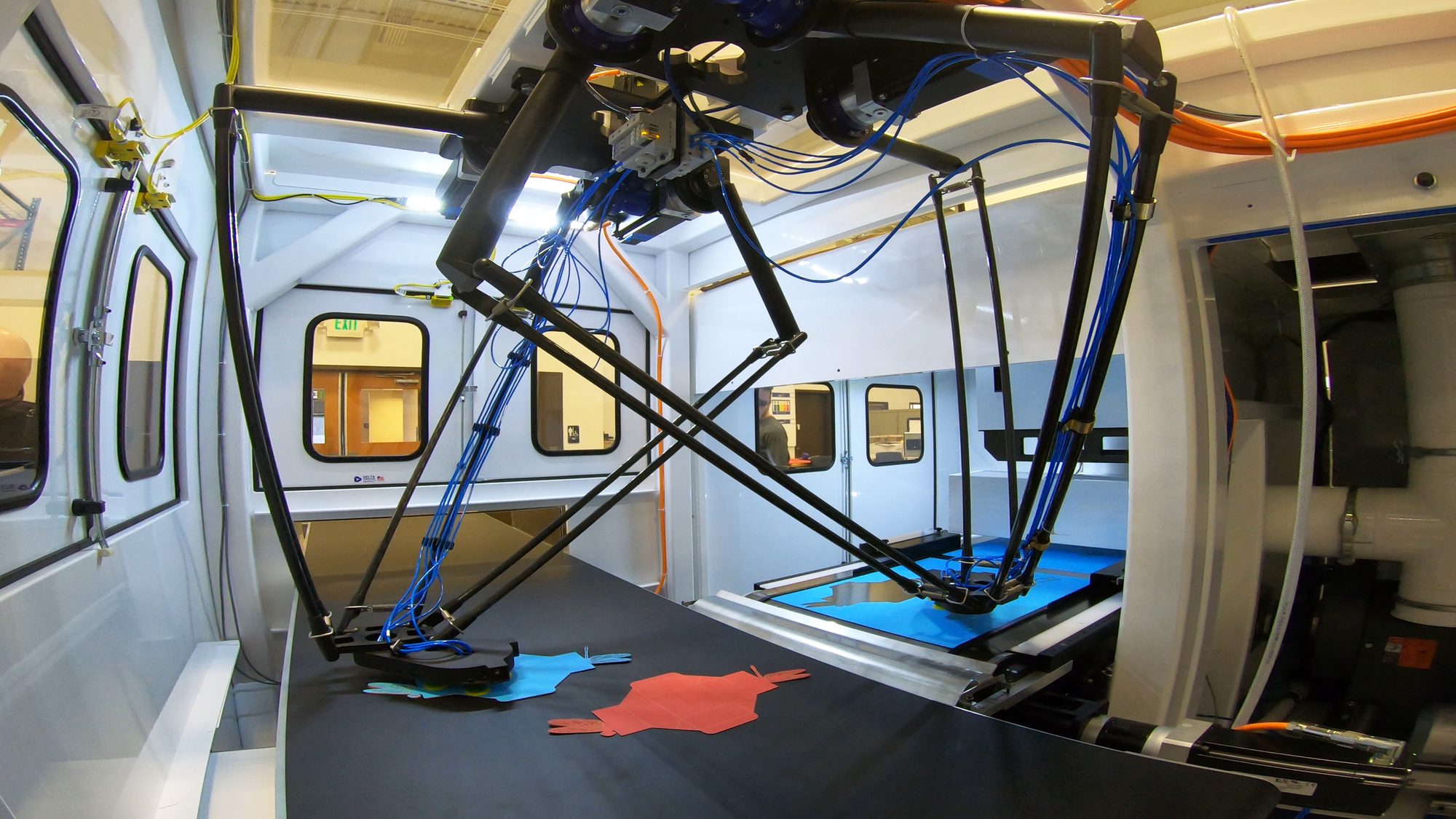
Most converters don’t want a new line — they want the line they have to do something it can’t. The LaserSharp® processing module is built for exactly that: it is configured for integration into existing presses, laminators, and slitter-rewinders with documented mechanical, electrical, and control interfaces. Modules integrated into third-party converting lines are this pattern in production.
On the floor
Questions buyers ask
Can you integrate into a line LasX didn't build?
Yes — LaserSharp® Modules are engineered for OEM integration, with mechanical and electrical envelopes and control handshake documentation, and are running today inside converting lines LasX did not build.
What does custom cost relative to a standard platform?
Custom work lands by scope: a module integrated into your existing press sits at one end; a fully custom line with automation at the other. The application development stage produces a defined scope — and a firm price — before you commit to the build.
What if application development shows the process doesn't work?
Then you've spent a study, not a machine. That is the point of the sequence — the expensive decision is only made after the cheap one has removed the uncertainty.