

Precision narrow-web converting
MicroLam™
MicroLam is a narrow-web roll-to-roll converting platform built around LaserSharp® Modules. The web path is configured to the application — unwind and rewind spindles, nip stations, and one to three LaserSharp® Modules are specified per machine — on a 100 mm or 350 mm web. A precision lamination station is an option for multilayer laminates. Web handling is cantilevered and rolls are loaded by hand, which keeps the machine compact and sets its limit at narrow web.
MicroLam's cantilever frame stops at narrow web — widths above 350 mm are quoted as custom equipment, and a mid-web line around 600 mm runs on FocusPro™.
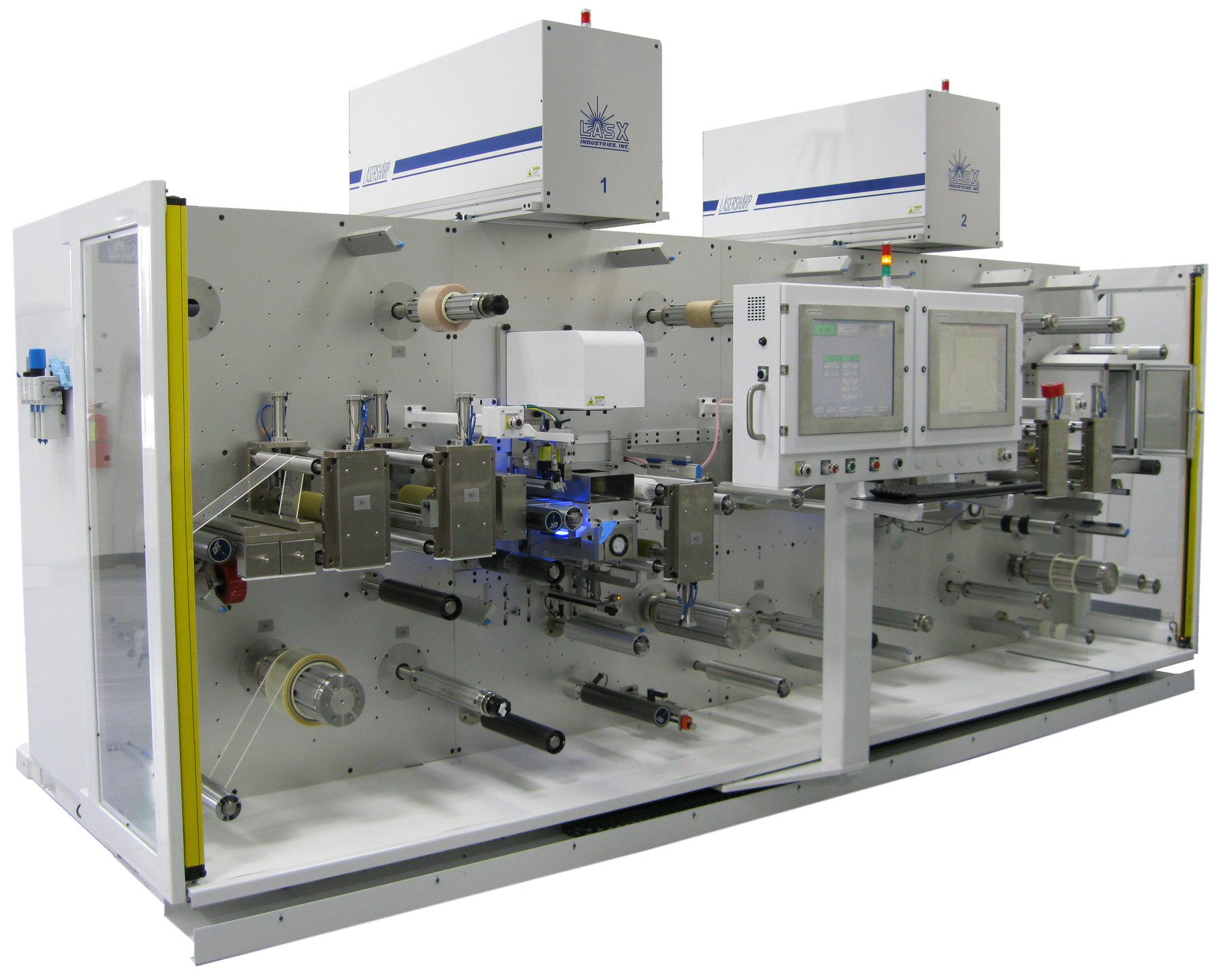
Specifications
| Web width | 100 mm or 350 mmWider webs are quoted as custom equipment. |
|---|---|
| Format | Narrow web, roll-to-roll |
| Web handling | Cantilever, with operator hand-loaded rollsRolls to about 23 kg (50 lb). The cantilever frame does not extend to mid- or wide-web. |
| LaserSharp® Modules | 1 to 3 |
| Spindles | Configured per applicationUnwind and rewind stations specified per application. |
| Nips | Configured per application |
| Precision lamination (option) | Patented (US 8,016,963) — the next layer's features are formed to the imaged positions of the previous layer's features, then the layers are laminated in register |
| Layer-to-layer registration | ~50 µm typical, with precision laminationMaterial and feature dependent; confirmed on your construction in the PhotonX trial. |
| Control | Proton λ process controller with LightGuide® interface |
| Laser safety | Class 1 laser product (embedded Class 4 laser)IEC 60825-1:2014 · 21 CFR 1040.10 and 1040.11, per Laser Notice No. 56 |
| Design life | 15+ years |
Configure-to-order
- Web width: 100 mm / 350 mm
- LaserSharp® Modules — 1 to 3, laser source selected on your material
- Spindle count and arrangement
- Nip station count
- Precision lamination station
- µVerify™ — in-line inspection that measures feature size and position and feeds closed-loop control of the laser parameters, plus Pulse beam confirmation. Which features are measured depends on the application.
A narrow web is a different problem from a wide one. Feature tolerance and web rate have to be met together on a compact, often expensive, material — and the machine should be built around exactly the stations the job needs, no more. A MicroLam without a lamination station is a complete narrow-web converting machine; the station is added when the product is a multilayer laminate.
Precision lamination (option)
Multilayer laminated products — microfluidic cartridges, diagnostic test strips, medical adhesive laminates, layered flexible circuits — fail at the interfaces between layers. Each layer can be converted accurately on its own and still land on the wrong spot of the layer beneath it, because webs stretch, drift, and rotate between stations.
Precision lamination solves this in the machine rather than in the tolerance stack. The first converted web is imaged as it runs; the controller measures where its features actually are, computes where the corresponding features in the next web must go, and the LaserSharp® Module forms them there — offset, rotation, and scale corrected — before the two webs are laminated. Every layer registers to the layer already on the web — typically within 50 µm, subject to the materials and the features being converted, and confirmed on your construction before a machine is quoted. The process is protected by US patent 8,016,963, held by LasX, and is added to MicroLam as an optional lamination station.
Questions buyers ask
When is a narrow-web platform the right choice over a wide-web machine?
When the product is a narrow roll — labels, medical laminates, adhesive components, flexible circuits — and the value is in precise features on a compact web rather than throughput across a wide one. A narrow-web machine also fits a smaller footprint and budget than a wide-web line.
Can MicroLam run a wider web?
Above 350 mm only as custom equipment, and not to mid-web. The cantilever web handling and hand-loaded rolls that keep MicroLam compact do not scale to a wide web — a converting line around 600 mm runs on FocusPro™, which is built in a 600 mm width for exactly that.
How is the web path configured?
The spindle count, nip stations, and number of LaserSharp® Modules — one to three — are specified per application during solution configuration, so the platform is built to the process rather than the process being adapted to a fixed machine.
What is precision lamination?
LasX's patented process (US 8,016,963), available on MicroLam as an optional station. A camera images the positions of features in the first converted web while it runs; the controller computes where the matching features must go in the next web — correcting offset, rotation, and stretch — and forms them there before the two webs are laminated. Layers register to each other, not to a nominal drawing — typically within 50 µm, depending on the materials and features in the web — which is what makes multilayer microfluidic, diagnostic, and medical laminates manufacturable roll-to-roll.