
Skip to content
LasX — The Laser Experts
Contact us

Capability

Laser Cutting

In converting, this is laser die cutting: the part outline comes from a file, not a steel-rule or rotary die. Laser cutting removes material with a focused beam rather than a blade. There is no tooling to buy, no tooling lead time, no mechanical wear, and no crush on compressible stock.
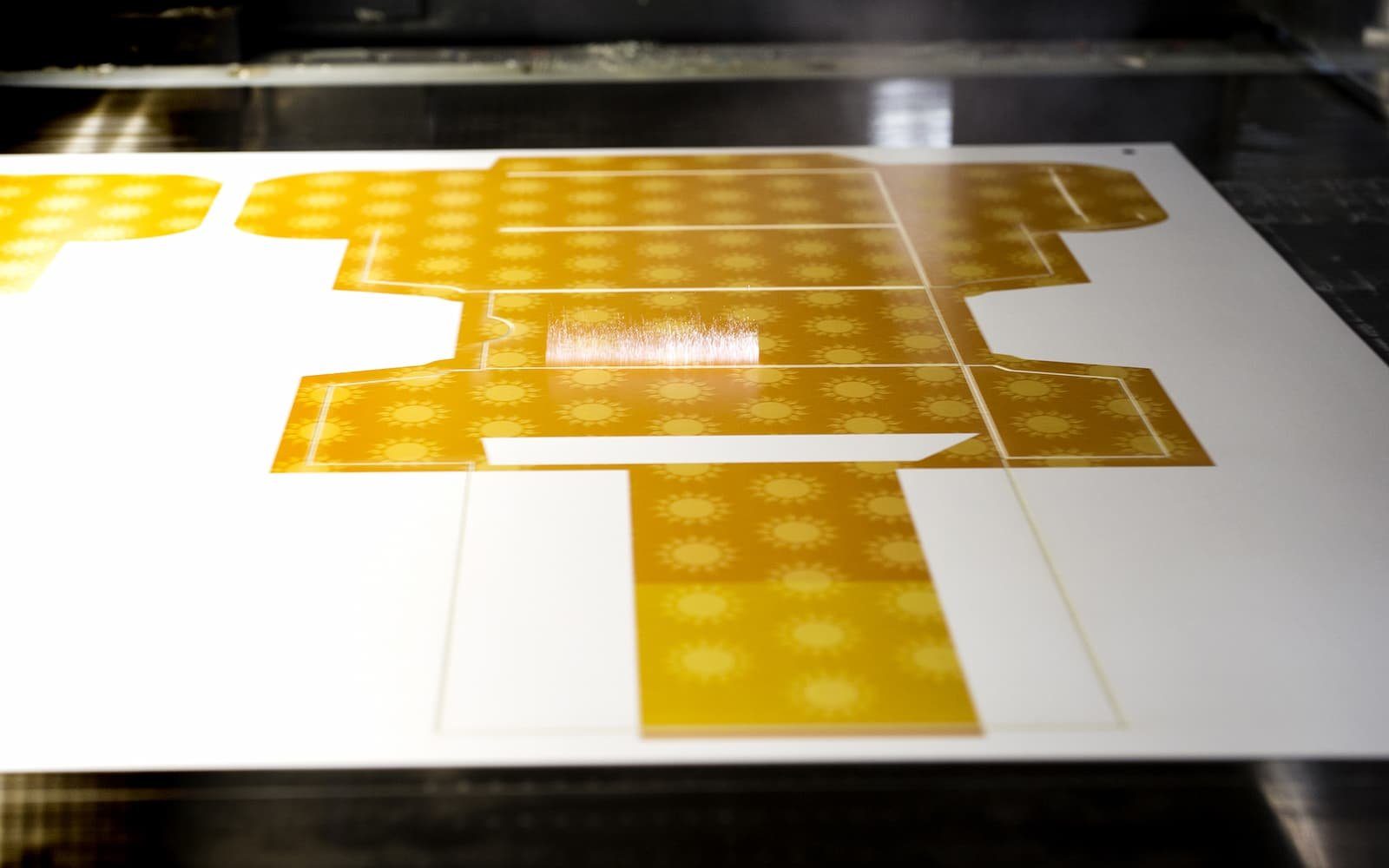
Laser cutting an intricate gold pattern sheet on the cutting bed

How it works

A focused beam vaporizes or ablates material along a digitally defined path. Power and speed set the cut depth, not a mechanical depth-stop. That is what makes kiss-cutting repeatable on adhesive-coated and release-lined constructions.

Why pulse duration sets the edge — the guide and heat-confinement map →

Process envelope

Wavelengths9.4 / 10.2 / 10.6 µm (CO₂), 1064 nm (NIR), 355 nm (UV)
Power rangeUp to 2.5 kW CO₂
Processing speedUp to 4,000 mm/sHighly material dependent.
Minimum feature25 µmNIR, green, or UV sources. 50 µm is the production minimum with CO₂ on flexible packaging.

The question is never whether a laser can cut a material. It is what the edge looks like afterward, and how fast you can go before it stops looking that way.

See it run

Wide-web foil processing system — Multi-module roll-to-roll laser processing of a wide metal-foil web.
Sheet-fed laser cutting with robotic sorting (Target, 2008) — Printed sheets fed through a LaserSharp machine, cut without a die and sorted by a delta robot — archival footage from a 2008 installation.
Printed flex circuits, sheet-fed (2020) — Vision-registered laser cutting of printed flexible circuits with robotic part removal on a SmartFinish system.
Robotic part removal after laser cutting — A delta robot lifts laser-cut parts off the cut sheet and re-nests them on the take-away belt — automated unloading after the cut. Archival LasX footage.
Repeating pattern die-cut on a moving web (2020) — A repeating outline laser-cut into a web as it moves continuously through the cutting field — no die, no stop between repeats. Footage from 2020.
Laser cutting on a rotating drum (2013) — A moving web cut while it rides a rotating drum. Flat-field optics have one focal plane and a curved surface does not — a coordinate transform and a fast-acting Z axis hold the focus.
Laser cutting abrasive discs from a moving web (2000) — A CO₂ laser cuts discs from a moving abrasive web; the waste skeleton is rewound and the discs leave on the conveyor. Archival footage, 2000.