

Material family
Polymers & Rigid Packaging for Marking
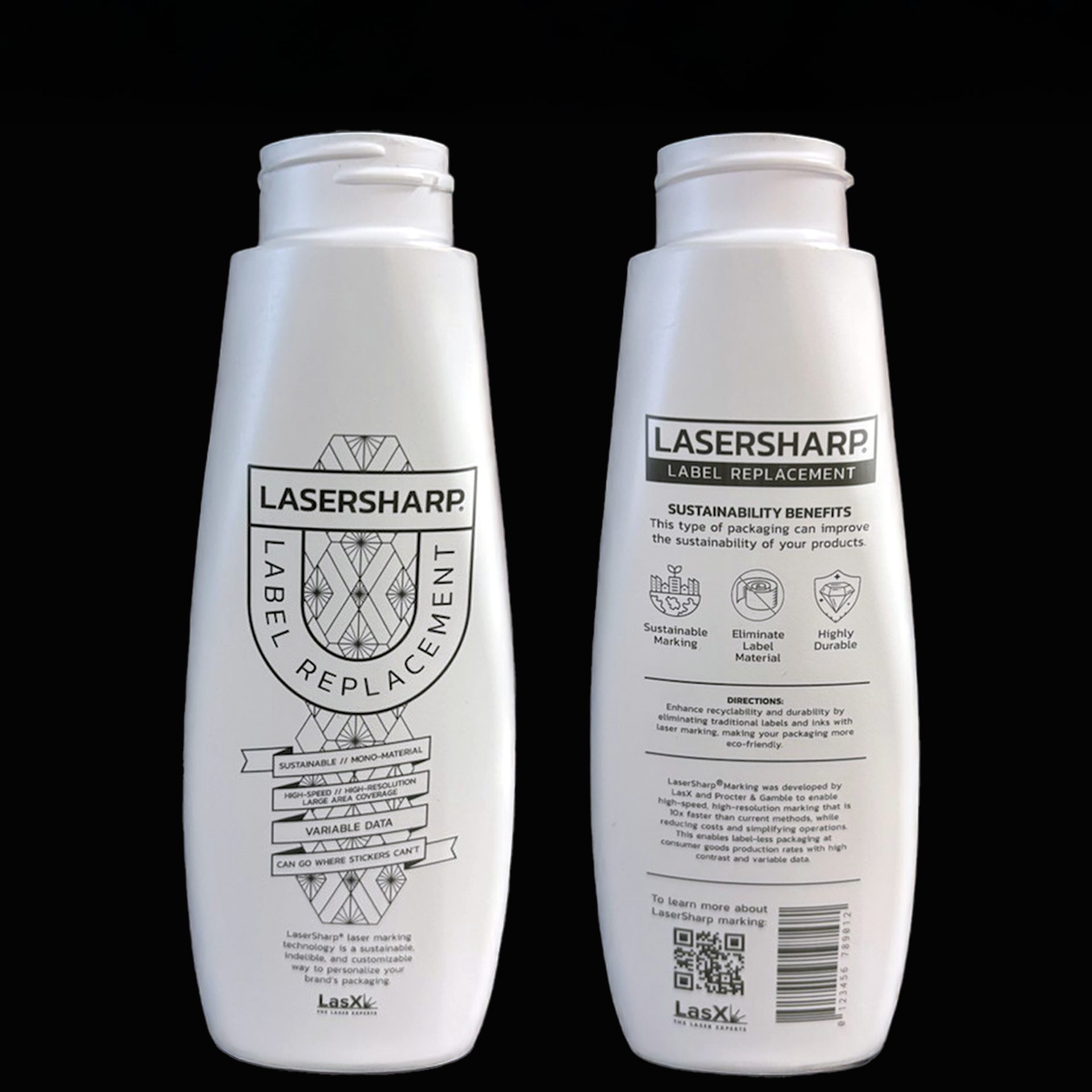
Polymers and packaging marked in the lab — PP, PE, HDPE, PET and compostable films as bottles, caps, films, blisters and cartons. No ink, label or consumable.
Also called: PP · PE · HDPE · PET · compostable film · blister pack · bottle marking · cap marking
- Wavelengths
- CO₂ 10.6 µm and 9.4 µm for surface-contrast marks on most polymers; green 532 nm for PET, HDPE and PP with no additive; UV 355 nm and NIR 1064 nm where a pigment or additive responds
- Pulse regime
- Modulated CO₂ for surface marks; picosecond green for additive-free marks on PET, HDPE and PP; nanosecond UV or NIR for color-change and additive-activated marks
- Why the pulse regime matters →
Why these wavelengths
How deep a wavelength penetrates before it is absorbed decides which layer it heats and how much of the pulse reaches the next one. This family’s materials are on the chart. Add others to compare. Every curve is computed from published optical constants, not from our own claims. The sources are in the table below the chart.
Materials on the chart — up to 6 at a time
Gold lines are the laser wavelengths LasX runs; click a laser label to jump to it. Curves stop where the material is transparent for practical purposes — polymers below 1 cm⁻¹ (the datasets’ detection floor), glasses below 0.01 cm⁻¹ (penetration beyond 1 m).
Values at the laser wavelengths, and sources
| Material | 355 nm | 532 nm | 1064 nm | 9.36 µm (9.4 µm laser line) | 10.2 µm | 10.6 µm | Source |
|---|---|---|---|---|---|---|---|
| TiO₂ (white pigment) | 16,447 cm⁻¹ 608 nm | 0.030 cm⁻¹ 34 cm | — | 390 cm⁻¹ 26 µm | 2,745 cm⁻¹ 4 µm | 4,891 cm⁻¹ 2 µm | Siefke et al. 2016 (ALD film) via refractiveindex.info, CC0 Intrinsic edge of the pigment material; a real white film also scatters. |
| PET (polyester) | — | — | — | 558 cm⁻¹ 18 µm | 471 cm⁻¹ 21 µm | 199 cm⁻¹ 50 µm | Zhang et al. 2020 (Appl. Opt. 59; JQSRT 252) via refractiveindex.info, CC0 Clear, additive-free resin. Below 1 cm⁻¹ the data sit at the detection floor and are not drawn — the film is transparent there. |
| PP + carbon black (0.5–1.5 wt%) | — | — | — | — | — | — | Ali et al. 2021, Front. Mater. 8, 737689 A NIR absorber added where polypropylene has none. |
| Polyethylene (HDPE / LDPE) | — | — | — | — | — | 9.6 cm⁻¹ 1.0 mm | Coelho et al. 2004, Polymer Testing 23, 307 Measured films at 10.6 µm; no strong band anywhere in the CO₂ range; transparent through the visible and NIR. |
| Polypropylene (BOPP / CPP) | — | — | — | — | — | 35 cm⁻¹ 290 µm | Coelho et al. 2004 (film); Kameyama et al. 2021 (sheet) Absorption peak near 10.2 µm (FTIR, Novanta 2021); measured at 10.6 µm; transparent through the visible and NIR. |
— : outside the dataset, or below its detection floor (transparent for practical purposes). Non-metals: α = 4πk/λ; penetration depth 1/α is where 63 % of the beam has been absorbed. Metals: A = 1 − R at normal incidence. All optical constants from the refractiveindex.info database (public domain, CC0); literature points as cited. Full source list and verification notes: docs/charts in the site repository.
Process data
| Mark contrast | Material-dependentSet by polymer chemistry, additive package, and wavelength. Screened per material in the lab. |
|---|---|
| Minimum readable feature | Trial data requiredSub-millimeter text and codes demonstrated. Measured per material and reader. |
| Marks per second at line speed | Trial data required |
| Mark durability | Trial data requiredAbrasion, chemical, and thermal exposure per the customer's specification. |
Entries marked “trial data required” have not been run on your specific construction. We publish only what we have measured.
What usually decides it
A mark is a controlled change to the surface, so the polymer decides more than the laser does. PET and coated board mark readily at CO₂ wavelengths. Natural PP and PE often need a laser-responsive additive or a UV source for contrast, though a picosecond green source marks PP and HDPE bare. The screening trial settles that first.
Marking replaces a consumable — ink, ribbon, or label — with a beam. What the beam can do depends first on how the polymer behaves when heated a few microns deep.
What we mark in the lab
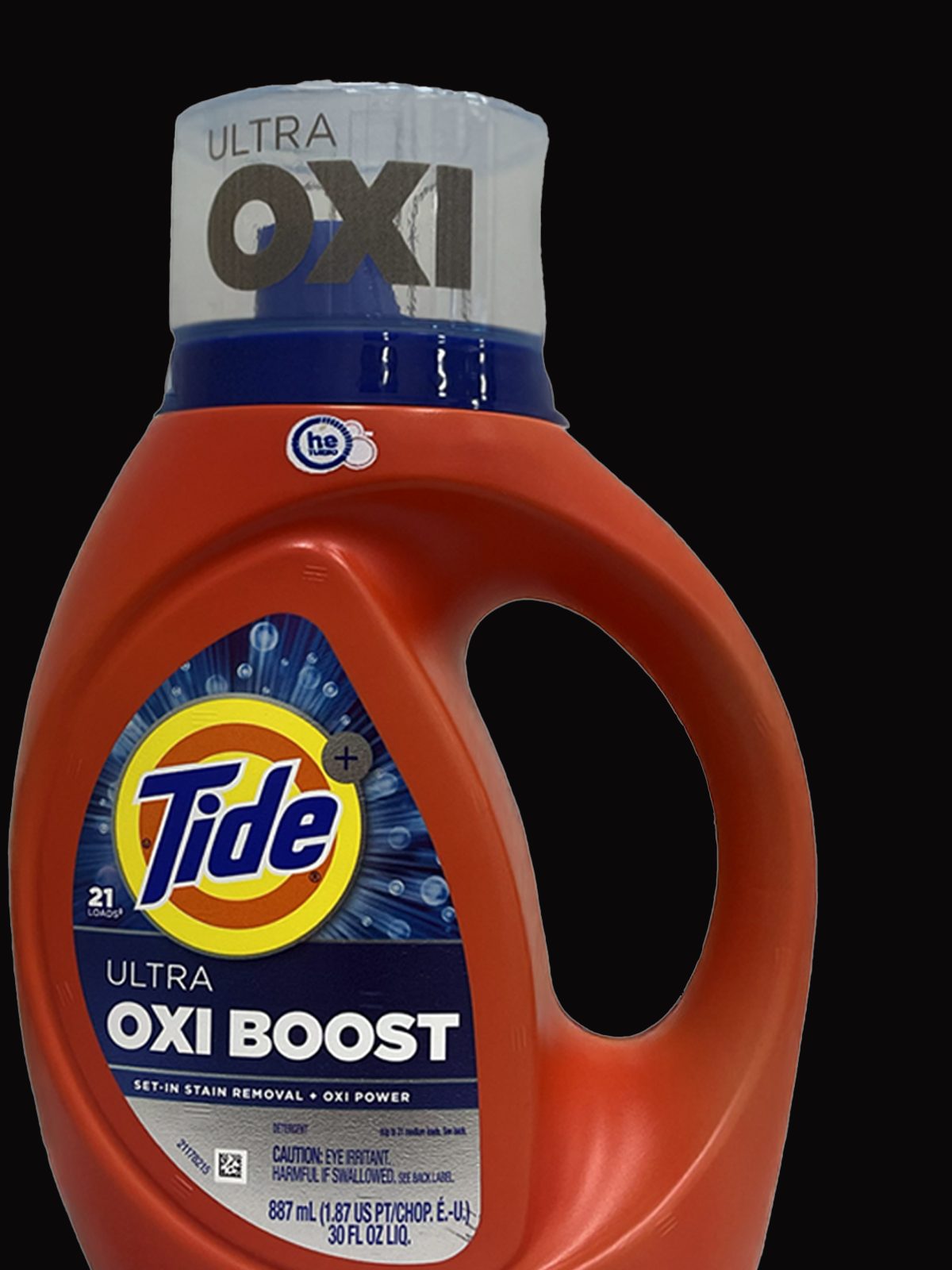
The PhotonX lab screens polymers and packaging forms for markability as a standard trial. Each sample runs across CO₂, NIR, green, and UV sources. It comes back with the best-contrast mark for each and the wavelength that produced it. Forms we mark routinely:
- Bottles and caps — PP, HDPE, and PET, marked on the curve with a 3-axis scanner so the code stays in focus around the radius.
- Films — mono-material PE and PP, PET laminates, and compostable films, marked on the web in register to print.
- Blister packs — lidding foil and thermoformed base, marked after forming so the code matches the contents.
- Cartons and labels — coated board and label stock, where the mark ablates a coating layer to reveal a contrasting layer beneath.
Why the material decides
- PET absorbs CO₂ light strongly and gives a bright, frosted mark with no additive.
- PP and PE are transparent to most wavelengths in their natural state. Contrast usually comes from a laser-responsive additive in the resin, or from a coated layer that the beam removes.
- Pulse duration changes that. A picosecond green source marks PET, HDPE and PP with no additive. Absorption at the wavelength is only part of the answer. How fast the energy arrives decides the rest.
- Compostable films are screened by formulation and layer construction. We assume no mark response from the material family alone.
- Coated board marks by removing the top coating to expose the substrate. Mark formation depends on the construction: coating removal, surface modification, or response within a laser-responsive material. The trial identifies the mechanism and the usable contrast.
For the marking process and equipment, see Marking and the MarkLine™ platform.
In production
See it run
Fill in the missing numbers with your actual material.
Every trial adds to the measured record behind these pages. It also adds to the process model we are building to predict the window before the first test piece is cut.